

Program Overview
This 8-week program is designed for intermediate lifters who have built a solid strength foundation and are ready to prioritize muscle hypertrophy. Using an upper/lower split, you'll train four days per week with strategically varied rep ranges, intensities, and training techniques to maximize muscle growth while managing fatigue.
The program alternates between accumulation phases (higher volume, moderate intensity) and deload weeks (reduced volume for recovery), followed by an intensification phase where loads increase and advanced techniques are introduced.
Prerequisites
- 6-12+ months of consistent resistance training
- Comfortable performing barbell squats, deadlifts, bench press, and overhead press with proper form
- Understanding of RPE (Rate of Perceived Exertion) and how to gauge effort
- Access to a fully equipped gym (barbell, dumbbells, cables, machines)
- Ability to commit to 4 training sessions per week (60-75 minutes each)
Who This Program Is For
- Lifters who have exhausted linear progression on a beginner program
- Anyone looking to shift focus from pure strength to muscle size
- Trainees who can train 4 days per week consistently
- Those who enjoy training variety and want to learn advanced techniques
Who This Program Is NOT For
- True beginners (less than 6 months of training experience)
- Lifters who can only train 2-3 days per week (consider a full-body program instead)
- Anyone currently dealing with a significant injury
- Those looking for a powerlifting-specific peaking program
Program Structure
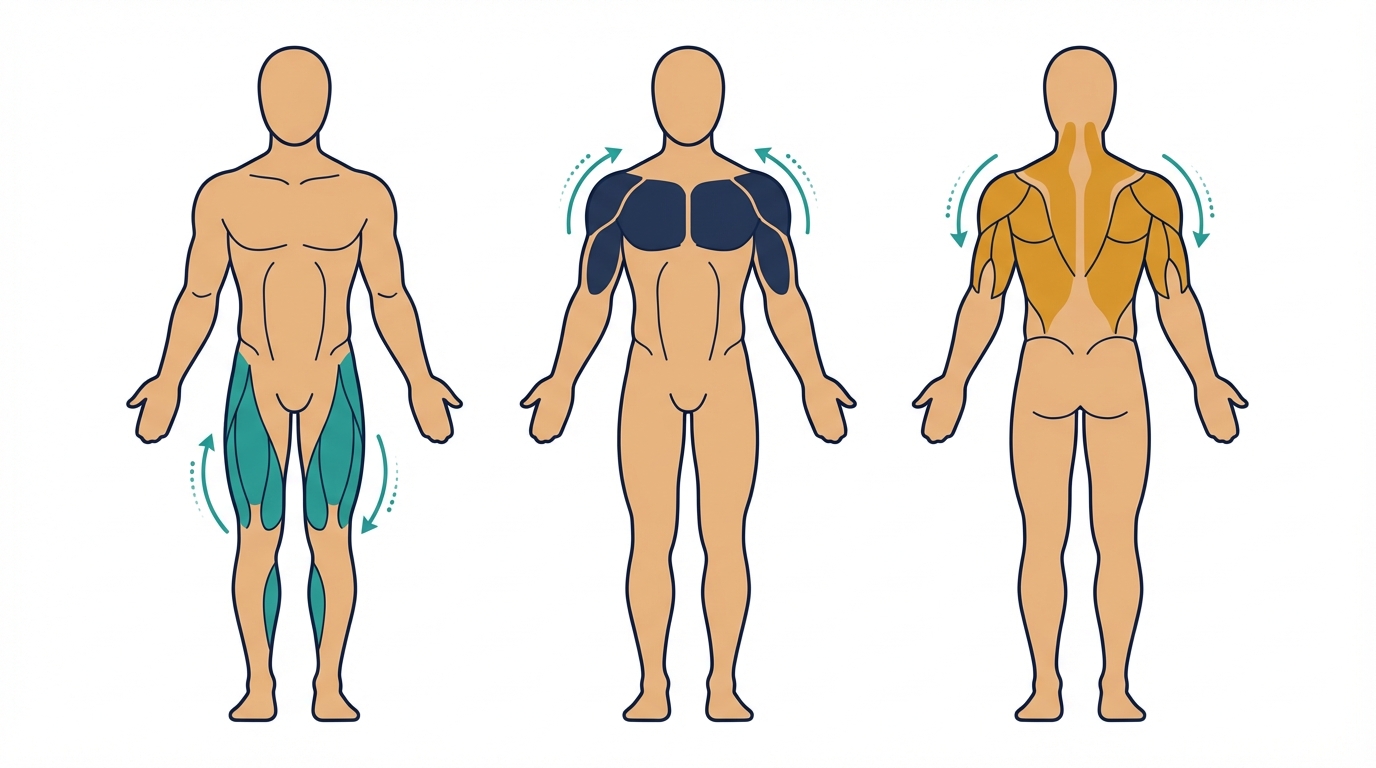
The program follows an upper/lower split with two distinct training days for each — an "A" day and a "B" day. This allows you to hit each muscle group twice per week with different exercise selections, rep ranges, and training stimuli.
| Day | Focus | Primary Emphasis |
|---|---|---|
| Monday | Lower Body A | Quad-dominant, heavy compounds |
| Tuesday | Upper Body A | Push-dominant, pressing strength |
| Wednesday | Rest | Active recovery or off |
| Thursday | Lower Body B | Hamstring/glute-dominant |
| Friday | Upper Body B | Pull-dominant, overhead work |
| Saturday | Rest | Active recovery or off |
| Sunday | Rest | Full rest day |
- Frequency: 4 days per week (upper/lower split)
- Session length: 60-75 minutes including warm-up
- Volume: 16-20 sets per muscle group per week
- Intensity: RPE 7-9 on working sets (varies by phase)
- Rest between sets: 2-3 minutes for compounds, 60-90 seconds for isolation
Training Plan
Below are the four training days with complete exercise prescriptions. All exercises are listed in order of priority — compound movements first, isolation work last. RPE targets are provided for the primary compound lifts; accessories should be taken close to failure (RPE 8-9) unless otherwise noted.
Monday: Lower Body A (Quad Focus)
| Exercise | Sets × Reps | RPE | Rest |
|---|---|---|---|
| Back Squat | 4×6-8 | 8 | 2-3 min |
| Romanian Deadlift | 4×8-10 | 7-8 | 2-3 min |
| Bulgarian Split Squat | 3×10-12 | 8 | 90 sec |
| Leg Press | 3×12-15 | 8-9 | 90 sec |
| Leg Extensions | 3×15-20 | 9 | 60 sec |
| Seated Calf Raise | 4×15-20 | 8-9 | 60 sec |
| Ab Wheel Rollouts | 3×10-15 | 8 | 60 sec |
Tuesday: Upper Body A (Push Focus)
| Exercise | Sets × Reps | RPE | Rest |
|---|---|---|---|
| Bench Press | 4×6-8 | 8 | 2-3 min |
| Barbell Row | 4×8-10 | 7-8 | 2-3 min |
| Incline DB Press | 3×10-12 | 8 | 90 sec |
| Cable Lat Pulldown | 3×10-12 | 8 | 90 sec |
| DB Lateral Raise | 3×12-15 | 8-9 | 60 sec |
| Cable Face Pull | 3×15-20 | 8 | 60 sec |
| Overhead Tricep Extension | 3×12-15 | 8-9 | 60 sec |
| Barbell Curl | 3×10-12 | 8 | 60 sec |
Thursday: Lower Body B (Hamstring/Glute Focus)
| Exercise | Sets × Reps | RPE | Rest |
|---|---|---|---|
| Conventional Deadlift | 4×5-6 | 8 | 3 min |
| Front Squat / Hack Squat | 4×8-10 | 7-8 | 2-3 min |
| Walking Lunges | 3×12/leg | 8 | 90 sec |
| Leg Curl | 4×12-15 | 8-9 | 60 sec |
| Hip Thrust | 3×12-15 | 8-9 | 90 sec |
| Standing Calf Raise | 4×12-15 | 8-9 | 60 sec |
| Hanging Leg Raises | 3×12-15 | 8 | 60 sec |
Friday: Upper Body B (Pull Focus)
| Exercise | Sets × Reps | RPE | Rest |
|---|---|---|---|
| Overhead Press | 4×6-8 | 8 | 2-3 min |
| Weighted Pull-ups / Pulldowns | 4×8-10 | 7-8 | 2-3 min |
| DB Bench Press | 3×10-12 | 8 | 90 sec |
| Cable Seated Row | 3×10-12 | 8 | 90 sec |
| DB Rear Delt Fly | 3×15-20 | 8-9 | 60 sec |
| Cable Chest Fly | 3×12-15 | 8-9 | 60 sec |
| DB Hammer Curl | 3×10-12 | 8 | 60 sec |
| Cable Tricep Pushdown | 3×12-15 | 8-9 | 60 sec |
Progression Strategy
The 8-week program is divided into two 4-week blocks. Each block follows a 3-week accumulation phase followed by a 1-week deload. The second block increases intensity and introduces advanced techniques.
8-Week Block Structure
| Weeks | Phase | Volume | Intensity | Focus |
|---|---|---|---|---|
| 1-3 | Accumulation Block 1 | Full prescribed volume | RPE 7-8 | Build work capacity, establish baselines |
| 4 | Deload Week | Reduce sets by 40-50% | RPE 5-6 | Recovery, joint health, technique refinement |
| 5-7 | Intensification Block 2 | Full prescribed volume | RPE 8-9 | Increase loads, add advanced techniques |
| 8 | Deload Week | Reduce sets by 40-50% | RPE 5-6 | Recovery, assess progress, plan next cycle |
Accumulation Weeks (1-3)
- Follow all exercises as prescribed with the listed sets, reps, and RPE targets
- Focus on establishing working weights and perfecting technique
- Aim to add small amounts of weight each week (2.5-5 lbs on compounds) when RPE allows
- Keep a training log — track all weights, reps, and RPE for every set
Deload Week (Week 4)
- Keep the same exercises and working weights
- Reduce total sets by 40-50% (e.g., 4 sets becomes 2 sets)
- RPE should be 5-6 — sets should feel easy and refreshing
- Maintain training frequency — still train all 4 days
- Use this week to address mobility or flexibility limiters
Intensification Weeks (5-7)
- Increase working weights by 5-10% over your Week 3 loads
- Push RPE targets up to 8-9 on compounds
- Introduce advanced techniques on the final set of isolation exercises (see Training Techniques below)
- Continue progressive overload — add weight when you hit the top of the rep range for all sets
Deload Week (Week 8)
- Same protocol as Week 4 — reduce volume, keep weights the same
- Assess your progress against starting numbers
- Plan your next training cycle based on what worked and what didn't
Progressive Overload Rules
| Scenario | Action |
|---|---|
| Hit top of rep range on all sets at target RPE | Increase weight by 2.5-5 lbs next session |
| Hit prescribed reps but RPE is 9-10 | Repeat same weight next session |
| Missed reps on 1-2 sets | Keep weight the same, aim for all reps next session |
| Missed reps on most sets | Reduce weight by 5-10%, rebuild over 2 weeks |
| Stalled for 2+ weeks on a lift | Swap exercise variation or adjust rep range |
Training Techniques
Progressive Overload Options
Hypertrophy doesn't require you to always add weight to the bar. There are multiple ways to progressively overload:
- Load progression: Add weight to the bar (primary method for compound lifts)
- Rep progression: Perform more reps at the same weight before increasing load
- Set progression: Add one additional set to an exercise (use sparingly)
- Tempo manipulation: Slow the eccentric (lowering) phase to increase time under tension
- Rest period reduction: Perform the same work in less time (increases metabolic stress)
Advanced Techniques (Weeks 5-7)
During the intensification block, apply these techniques to the final set only of isolation exercises. Do NOT use them on heavy compound lifts.
| Technique | How To Apply | Best For |
|---|---|---|
| Drop Sets | After final set to failure, reduce weight by 20-30% and continue for 6-10 more reps | Isolation exercises (curls, extensions, raises) |
| Rest-Pause | After reaching failure, rest 10-15 seconds, then perform 2-4 more reps. Repeat once. | Machine exercises (leg press, chest fly) |
| Slow Eccentrics | Lower the weight over 4-5 seconds on each rep of the final set | All exercises — especially effective on pulls |
| Partial Reps | After reaching failure, perform 4-6 partial range reps to extend the set | Cable exercises (face pulls, lateral raises) |
| Myo-Reps | Perform an activation set of 12-15 reps, rest 5s, do 3-5 reps, repeat 3-4 times | High-rep isolation work (15-20 rep range) |
Form Video Guides
Proper form on compound lifts is critical for both safety and muscle activation. Watch these guides for the main movements in this program.
Barbell Back Squat
Barbell Bench Press
Romanian Deadlift
Barbell Overhead Press
Barbell Row
Lat Pulldown
Warm-Up Protocol
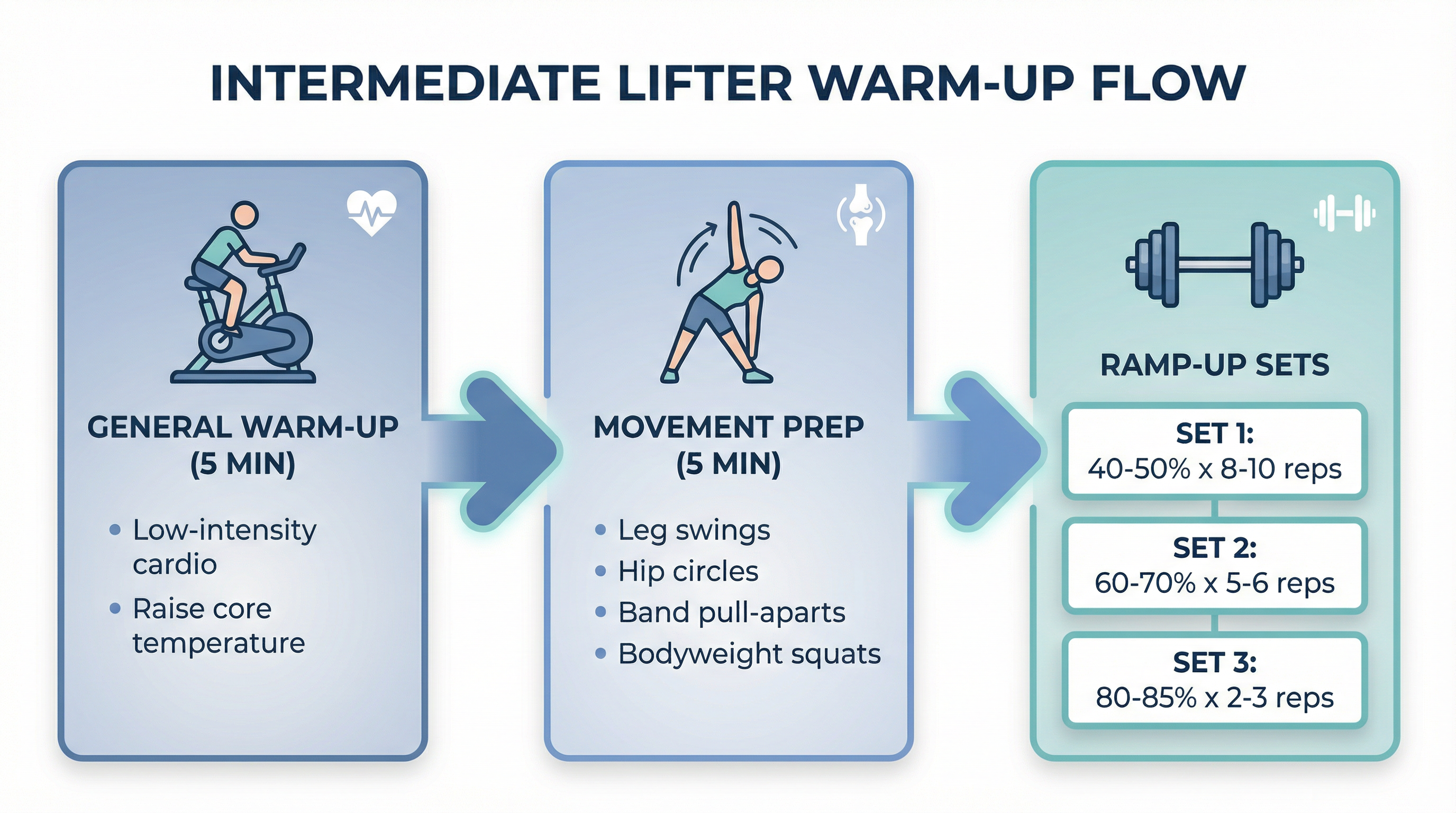
A proper warm-up prepares your joints, muscles, and nervous system for heavy training. Budget 10-15 minutes before every session.
General Warm-Up (5 minutes)
Start with 5 minutes of low-intensity cardio to raise core temperature and increase blood flow:
- Stationary bike, rowing machine, or brisk walking
- Heart rate should be mildly elevated — you should be able to hold a conversation
- Light sweat is a good indicator you're ready to move on
Movement Prep (5 minutes)
Dynamic Mobility Drills
| Drill | Target Area | Reps / Duration |
|---|---|---|
| Leg Swings (front/back) | Hips, hamstrings | 10 per leg |
| Leg Swings (side-to-side) | Adductors, hip abductors | 10 per leg |
| Hip Circles | Hip capsule, glutes | 10 per direction |
| Arm Circles (small to large) | Shoulders, rotator cuff | 15 per direction |
| Cat-Cow Stretches | Thoracic spine, lower back | 10 reps |
| Band Pull-Aparts | Rear delts, upper back | 15-20 reps |
| Bodyweight Squats | Full lower body | 10-15 reps |
Specific Warm-Up (before each compound lift)
Before your first heavy compound exercise of the day, perform ramp-up sets to prepare the specific movement pattern:
Ramp-Up Sets
| Set | % of Working Weight | Reps | Purpose |
|---|---|---|---|
| Warm-up 1 | 40-50% | 8-10 | Groove the movement pattern |
| Warm-up 2 | 60-70% | 5-6 | Increase neuromuscular readiness |
| Warm-up 3 | 80-85% | 2-3 | Final preparation, build confidence |
Nutrition for Hypertrophy
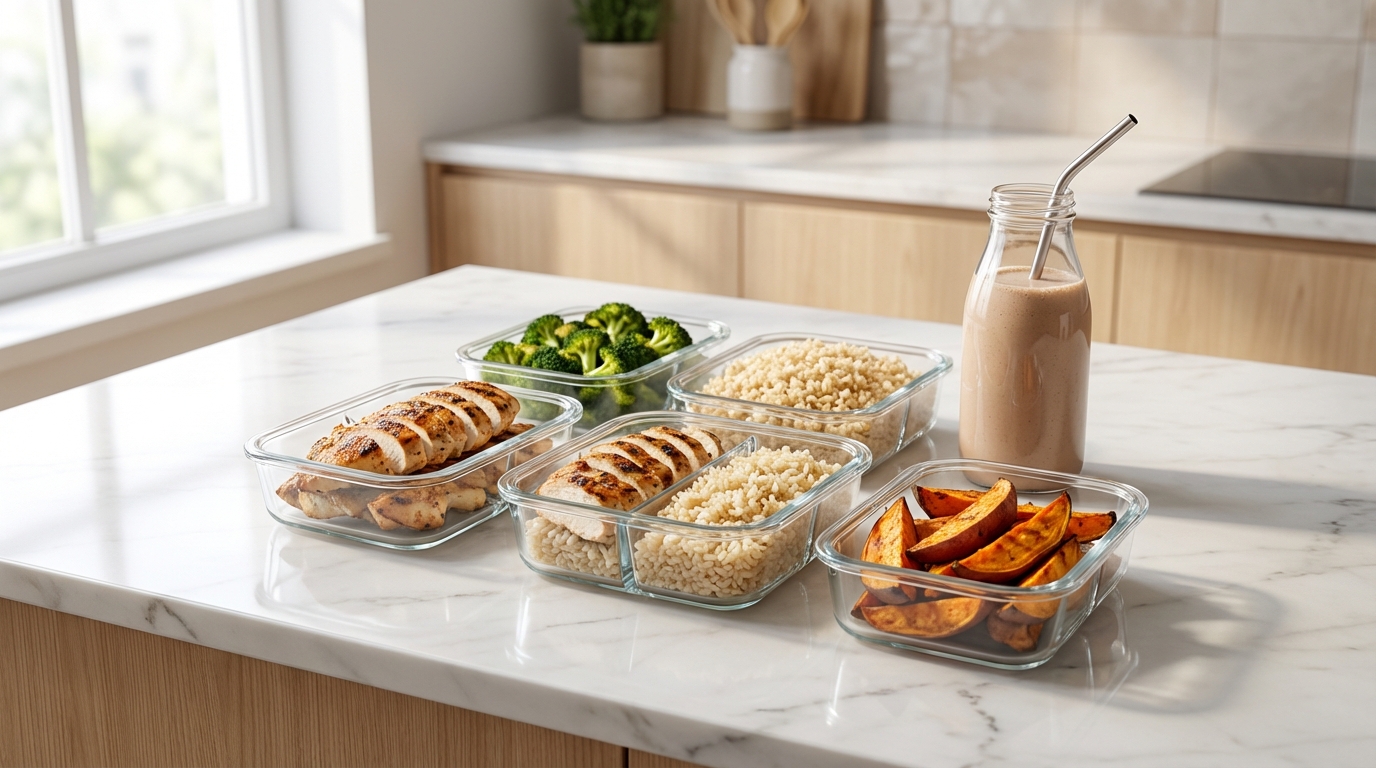
Muscle growth requires a caloric surplus combined with adequate protein, carbohydrates, and fats. Training provides the stimulus — nutrition provides the raw materials for growth.
Caloric Surplus
To maximize muscle growth while minimizing fat gain, aim for a moderate caloric surplus of 250-500 calories above maintenance. This supports approximately 0.5-1 lb of weight gain per week — the optimal rate for lean muscle accrual.
Caloric Intake Guidelines
| Goal | Daily Surplus | Expected Weekly Gain | Best For |
|---|---|---|---|
| Lean bulk (recommended) | +250-350 calories | 0.5-0.75 lbs/wk | Minimizing fat gain while building muscle |
| Standard bulk | +350-500 calories | 0.75-1.0 lbs/wk | Maximizing muscle growth potential |
| Maintenance recomp | 0 (at maintenance) | Scale weight stable | Body recomposition (slower muscle gain) |
Macronutrient Targets
Daily Macronutrient Recommendations
| Macronutrient | Target | Role in Hypertrophy |
|---|---|---|
| Protein | 1.6-2.2g per kg bodyweight | Muscle protein synthesis, recovery |
| Carbohydrates | 3-5g per kg bodyweight | Training fuel, glycogen replenishment, anabolic signaling |
| Fats | 0.7-1.2g per kg bodyweight | Hormone production (testosterone), joint health, satiety |
Supplementation
Supplements are not required but can fill nutritional gaps and support training performance:
Evidence-Based Supplements
| Supplement | Dose | Benefit | Priority |
|---|---|---|---|
| Creatine Monohydrate | 3-5g daily | Increases strength, power output, and muscle cell hydration | High |
| Whey Protein | 20-40g post-workout | Convenient way to hit protein targets | Medium |
| Caffeine | 3-6mg/kg pre-workout | Improves focus, strength, and endurance | Medium |
| Vitamin D | 2000-5000 IU daily | Supports hormone production and immune function | Medium |
| Fish Oil (Omega-3) | 2-3g EPA/DHA daily | Reduces inflammation, supports recovery | Low-Medium |
| Magnesium | 200-400mg daily | Sleep quality, muscle relaxation, recovery | Low |
Recovery Protocols

Recovery is where muscle growth actually happens. Training creates the stimulus; recovery allows adaptation. Neglecting recovery is the number one reason intermediate lifters plateau.
Sleep
- Aim for 7-9 hours of quality sleep per night — this is non-negotiable for hypertrophy
- Growth hormone is released primarily during deep sleep; poor sleep directly impairs muscle growth
- Keep a consistent sleep schedule (same bedtime and wake time, even on weekends)
- Avoid screens 30-60 minutes before bed; dim lights to support melatonin production
- Keep your bedroom cool (65-68°F / 18-20°C) and dark
Active Recovery
- Rest days: Light walking (20-30 min), mobility work, or gentle yoga
- Foam rolling: 5-10 minutes targeting worked muscle groups to reduce soreness
- Light cardio: 20-30 minutes at low intensity (zone 2) on rest days promotes blood flow without adding fatigue
- Avoid intense cardio or sports activities that could impair recovery from weight training
Stress Management
Chronic stress elevates cortisol, which directly impairs muscle protein synthesis and recovery. Manage stress through:
- Meditation or deep breathing exercises (even 5-10 minutes daily helps)
- Time management — training shouldn't feel like another source of stress
- Social connection and hobbies outside the gym
- If life stress is high, consider reducing training volume temporarily rather than pushing through
Monitoring Recovery
Track these indicators to ensure you're recovering adequately between sessions:
Recovery Indicators
| Indicator | Good Sign | Warning Sign |
|---|---|---|
| Performance | Strength stable or increasing | Strength declining for 2+ sessions |
| Morning resting heart rate | Consistent day-to-day | Elevated 5+ bpm above baseline |
| Sleep quality | Falling asleep within 15-20 min | Difficulty falling or staying asleep |
| Muscle soreness | Mild and resolves within 48 hrs | Persistent soreness lasting 3+ days |
| Joint health | No pain during or after training | Aching joints that worsen over time |
| Motivation | Looking forward to training | Dreading sessions or feeling apathetic |
| Appetite | Normal or increased | Suppressed appetite or nausea |
Modifications
Equipment Substitutions
If you don't have access to specific equipment, use these substitutions:
| Exercise | Substitution Option 1 | Substitution Option 2 |
|---|---|---|
| Back Squat | Leg Press | Goblet Squat (heavier DB) |
| Conventional Deadlift | Trap Bar Deadlift | Barbell RDL + Back Extension |
| Bench Press | DB Bench Press | Machine Chest Press |
| Overhead Press | Seated DB Press | Landmine Press |
| Weighted Pull-ups | Lat Pulldown | Band-Assisted Pull-ups |
| Cable Lat Pulldown | DB Pullover | Band Pulldown |
| Cable Face Pull | Band Face Pull | DB Rear Delt Fly |
| Leg Press | Hack Squat | Heavy Goblet Squat |
| Hip Thrust | Glute Bridge (barbell) | Cable Pull-Through |
Time Constraints
If you're short on time, prioritize exercises in order (compound lifts first) and apply these modifications:
- 45-minute sessions: Drop the last 1-2 isolation exercises from each day
- 3 days/week only: Combine Lower A + Upper A on Day 1, rest Day 2, Lower B + Upper B on Day 3 (reduce sets by 30%)
- Superset accessories: Pair non-competing exercises (e.g., curls with tricep pushdowns) to save time
Working Around Injuries
- Shoulder pain on pressing: Switch to neutral grip DB presses, reduce incline angle, add extra face pulls
- Lower back discomfort: Replace conventional deadlift with trap bar or RDL, use belt squats if available
- Knee pain on squats: Reduce depth to parallel, try box squats, emphasize hip-dominant movements
- Elbow pain on curls/extensions: Switch to hammer grip variations, reduce frequency, add wrist warm-up drills
Expected Results
Results depend on training history, nutrition adherence, genetics, sleep quality, and stress levels. Here are realistic expectations for intermediate lifters following this program with good nutrition:
8-Week Expected Outcomes
| Metric | Realistic Range | Notes |
|---|---|---|
| Muscle gain | 2-4 lbs lean mass | Assumes moderate caloric surplus |
| Strength increase (compounds) | 5-15% on major lifts | Higher for lifts with more room to grow |
| Body composition | Visible improvement in muscularity | Most noticeable in arms, shoulders, and legs |
| Work capacity | Significantly improved | Ability to handle more volume per session |
| Body weight change | +3-6 lbs total | Mix of muscle, glycogen, and some fat |
| Measurements (arms, chest) | +0.25-0.75 inches | Measure at same time of day, flexed |
Frequently Asked Questions
Q: Can I add extra arm or shoulder work?
The program already includes dedicated arm and shoulder isolation on both upper body days. If you feel they're lagging, you can add one extra set per exercise rather than adding new exercises. More is not always better — recovery matters.
Q: Should I do cardio on this program?
Light cardio (20-30 min of walking or cycling) on rest days is fine and even beneficial for recovery. Avoid intense HIIT or long-duration cardio that could impair muscle recovery. If fat loss is a goal, manage it primarily through diet rather than excessive cardio.
Q: What if I can't do weighted pull-ups?
Use the lat pulldown machine instead. Once you can do 3 sets of 10-12 bodyweight pull-ups with good form, start adding weight using a dip belt or holding a dumbbell between your feet.
Q: Can I rearrange the training days?
Yes, as long as you maintain the alternating pattern (lower/upper/rest/lower/upper). Avoid training the same muscle groups on consecutive days. For example, Mon/Tue/Thu/Fri or Tue/Wed/Fri/Sat both work well.
Q: How do I know when to move to an advanced program?
After completing 2-3 cycles of this program (16-24 weeks), if you're no longer making progress despite good nutrition and recovery, you may benefit from more advanced programming with greater exercise variation, periodization complexity, or specialization phases.